"A book is the best of friends, the same today and forever." ~ Martin Tupper
Showing posts with label discoveries. Show all posts

Sunday, September 3, 2017

Seeing Spots 2

Better known as Firehouse mascots, Dalmation dogs are easily identified by their spots (even in their mouths!), though they are born without any.  It takes about 4 weeks for spots to appear on their little snow-white bodies.  Dalmations are excellent companions for hunters, or as trail hounds, and are energetic retrievers with exceptional memories. While a great many Dalmations can’t hear very well, their good looks and friendly personalities keep them in spotlights such as circus acts, movies and TV commercials. You might never guess that coaching is their favorite thing to do as they run alongside teams of horses pulling coaches. They’re quite good at keeping stray dogs and other obstacles away. And it’s easy to see that Dalmations are very good friends with horses, such as the Appaloosa.

Definitely show-worthy horses and one of the most popular breed in the US (State horse of Idaho), Appaloosas have appeared in old Western movies, cartoons for children, and TV commercials. Their vision is not good at night but that has not stopped the beautiful Appaloosas from racing and even winning in Kentucky Derby races.


While they might not win any races, Spotted Turtles are incredibly active during the day and their shiny black shells with bright yellow spots (females have yellow chins!) are always amazing to look at. The Spotted Turtle can be found in swampy regions of Florida and similar areas in Canada. They enjoy foraging in leaves on land sometimes, though most of their hunting is done underwater where swamp mud is also a great place to hide from predators or when hibernating.


Are you seeing spots at your house?

Monday, June 26, 2017

Seeing Spots


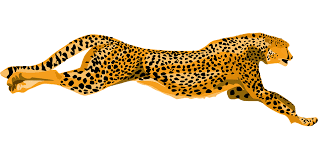
Smallest of the ‘Big Cat’ family, Cheetahs are often mistaken for Leopards, but Cheetahs have round, solid black spots and black ‘tear’ tracks from the corner of their eyes to the top of their mouths, on either side of their noses. This helps deflect the sun from their eyes as they hunt during the day. Exceptional eyesight allows the Cheetah to see its prey 3 miles away! Lanky and built for speed; they are the fastest land mammals on earth.  Cheetahs cannot roar. Instead, they purr, and chirp, churr, yowl – and growl. Non-retractable claws and rubber-like paw pads prevent the Cheetah from climbing trees but provide excellent traction for quick turns during high-speed chases. Ancient Egyptians once kept Cheetahs as pets and hunting partners, though they are now considered an endangered species.

Leopards have brown/black blotches that some describe as ‘roses’ or ‘wings.' These blotches offer optimal camouflage and allow the leopard to easily sneak up on his prey. Occasionally, the Leopard’s dark blotches are so numerous as to appear one solid color and he is mistaken for a Black Panther. Though not as fast as the Cheetah, the Leopard is much more powerful and can drag his lunch all the way up a tree and stash it there for later enjoyment. Though Leopards do indeed roar, they usually bark when they have something to say. Some folks believe the bones and whiskers of the Leopard can heal sick people, which may have contributed to their dwindling number. They can be found in many environments, including wetlands, rainforests, deserts, and coastal scrubs.

Could you tell them apart (without reading the sign at the zoo)?


Saturday, April 1, 2017

Words to Work With 1

“Choose a job you love, and you’ll never have to work a day in your life” ~ Confucius


From sweeping porches to cleaning windows, there’s something just so satisfying about getting paid for a job well done. Before long, we realize that bigger jobs mean bigger paychecks. So whether you’re thinking of what job you will have, or which you would have liked to have, I’d love to hear which jobs seem appealing, or which ones absolutely don’t ;-)

A.      Acrobat, Astronaut, Actor, Autopsy assistant, Airplane Recovery Agent
B.      Brain Surgeon,  Bookkeeper, Brick Mason
C.     Coach, Car mechanic, Chef, Childcare worker, Chocolate Engineer, Crime Scene Cleaner
D.      Doctor, Dentist, Dog walker/Trainer, (Film) Director
E.      Electrician, Editor, EMT, Economist, Embalmer
F.      Farmer, Firefighter, FBI Agent, Flight Attendant, Fortune Cookie Writer
G.     Government worker, Geologist, Glazier, Gum Buster, Grave Digger
H.     Healthcare, Home Inspector, Housekeeper, Hot Walker, Hot Dog Vendor
I.       Insect conservation specialist, Ice Skater, Insurance Agent, Ice Cream Taster, Ice Sculptor


I.     

Monday, January 2, 2017

Happy Trails for 2017!


It’s International Wayfinding Month!  A global celebration of all the handy tools and signs we use every single day to help us find our way.

Even before we had cities and cars, people made markings (petroglyphics) on cave walls and canyon passes to show new travelers what to expect, for instance animals – or warriors (eep!).

 Many of the signs we use today are quite clever

And a few are a little confusing

Before the invention of the compass, people generally relied upon the sun, the stars or landmarks seen from ships at sea for navigation. On land it is well known that the sun rises in the east and sets in the west. However, due to seasonal changes in latitude which occur during summer and winter, travelers can become quite lost if they don’t know which pole (North or South) is currently pointing to the sun. And what if you happen to be lost on a cloudy day? No worries with a trusty compass!

Has there ever been a time you could have used a handy tool or sign? Which one helped you find your way?

Wednesday, September 7, 2016

Harvesting Lunar Interest


“The night walked down the sky with the moon in her hand.” ~Frederick L. Knowles

Perhaps upon a starry night – about 4.5 billion years ago--two planets collided in the solar system and all the debris from that wreck formed a single planet we call the Moon. In its early days, the moon had active volcanoes and fire fountains. The volcanoes no longer erupt, and you can now find orange-colored moon rocks; left over from the flaming fountains. Every once in a while there are Moonquakes; almost like what we have on earth.


Only 12 people have ever been, though one day everyone will likely be able to visit the moon, as well as other planets. But if you plan on going, keep in mind it will take about nine years to walk there or 135 hours by car. Don’t worry if the moon doesn’t look quite the same up close, it’s not really round (as it appears from Earth) but egg-shaped.

In the month of September our full moon (Sept. 16th) is called the Harvest Moon because it’s the season when fruit and vegetable crops are ready to be gathered from the fields, and the brightness of the moon allows the farmers longer days to do so. Sometimes the Harvest Moon is an autumn orange color due to its closeness to earth and all the dust in our atmosphere.

This year September will have an extra full moon (Sept. 30th) called the Blue Moon, which is pretty special since it only happens every two years or so. It is believed the Blue Moon got its name after a massive volcano (Krakatoa) eruption in 1883 spewed blue smoke into the atmosphere.

Would you go to the moon? Have you ever worked or played by the light of a big full moon?
 

By all these lovely tokens September days are here
with summer's best of weather and autumn's best of cheer.
- Helen Hunt Jackson